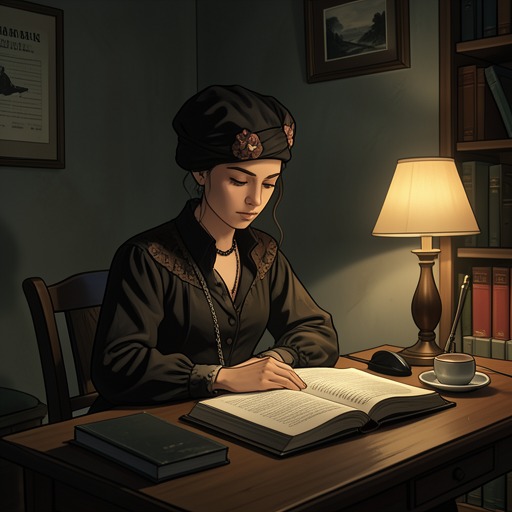
La littérature comme secours et déclencheur d’émancipation
L'Amour et les ForêtsLa littérature comme secours et déclencheur d’émancipation describes reading as more than consolation: a book can keep a reader oriented toward life and help make self-transformation imaginable. The idea emerges through Bénédicte Ombredanne’s response to Éric Reinhardt’s novel, which she reads as a demonstration that a person divided among conflicting selves can still become whole enough to act. For her, fiction’s rescue lies not in escape alone, but in making another life seem possible—and therefore available to be made real.
Books as a lifeline
Bénédicte’s earliest letters convey distress indirectly. She does not explain what obstructs her happiness, or whether the source lies within herself, at work, or in her family. Instead, Éric Reinhardt senses her condition in the gaps and impediments her writing evokes, and in the fierce will to resist them. Her books matter with an intensity that suggests necessity rather than pastime: she appears to approach beloved works as a castaway might cling to a buoy, waiting for rescue from a life in which she has nearly resigned herself to a slow death.
That image also implicates the author. Reinhardt recognizes in Bénédicte’s expectations something close to his own: he, too, hopes that the books he writes will carry him elsewhere and bring him to a more ideal shore. The exchange therefore presents literary rescue as reciprocal, even when the relation is unequal. The reader imagines a book turning toward her and its author as a distant captain who has noticed her in the water; the author understands that longing because he also seeks shelter and passage through literature.
The novel’s divided selves
Bénédicte reads the novel’s four protagonists not as unrelated lives but as variations of one person. Their circumstances diverge after a shared childhood: one becomes a London hedge-fund owner, another a long-term unemployed man living in seclusion with his mother, another a geologist working in Germany, and another a writer who spends time at the Le Nemours café near the Palais-Royal. The narratives never meet, yet their common identity gradually becomes legible beneath their contrasting social roles. To Bénédicte, their separate trajectories are not proof that a self is irreparably broken; they are material from which a fuller self can be composed.
She understands the act of composition as a form of reconciliation. When the different lives are placed together, she argues, a three-dimensional person emerges, with fewer gaps even if the joins remain visibly cracked. The novel’s writer-character, identified as Éric Reinhardt, seems to contain the other versions and to gather their scattered qualities. This structure offers Bénédicte a way to think about inner contradiction: people can be plural, divided, and pulled by incompatible interests without that plurality making them false or worthless.
The prospect of unity does not require erasing difference. In her reading, the characters’ shared essence persists through their different environments and experiences, much as the same ingredients can be combined in different proportions. The resulting person is not a flawless, seamless figure. The remaining fissures matter: reconciliation means being able to inhabit a complicated identity, not pretending that its contradictions have disappeared.
Reading as self-recognition
Bénédicte says that reading the novel made her feel better and gave her the conviction that a fragmented person could become more integrated. She particularly values its writer-character, who alone sometimes finds happiness or calm, notices clearings in experience, and turns them into moments of insight. Unlike the other figures, this character does not become lost in the same painful labyrinths. Bénédicte takes his capacity to accept his own strangeness and make it a source of joy as a possible practice for life.
The novel thus offers recognition without reducing its reader to a single role. Bénédicte sees herself reflected across several characters, especially in the figure who seems to hold the others within him. That imaginative movement matters because it lets a reader acknowledge traits and desires that might otherwise remain concealed, disowned, or disguised for fear of other people’s judgment. Literature becomes emancipatory when it allows complexity to be recognized as a strength rather than treated as a defect that must be suppressed.
Fiction and the invention of a life
Bénédicte had never heard of Éric Reinhardt before a bookseller recommended the novel. She therefore encountered the author who appears in it as a fictional character, no more documentary or authoritative than the other three protagonists. This distance made the whole book feel invented to her, even where it drew on the author’s life. She found freedom in that uncertainty: if the apparent facts could be reinvented as fiction, then a life itself might also be invented.
Her conclusion is not that fantasy alone can replace reality. The life imagined must become real, just as the novel exists concretely in a reader’s hands, with its blue cover and white pages. She takes the book as permission to begin inventing herself day by day, and to do so again whenever she can. This is an aspiration and a lesson she draws from reading, not evidence that her circumstances have already changed. The distinction gives the novel’s promise its stakes: imagination opens a possibility, but emancipation depends on bringing that possibility into lived existence.
Literary kinship and the limits of rescue
The idea also grows from Bénédicte’s wider literary affinities with Reinhardt. At their spring conversation at the Le Nemours café near the Palais-Royal, they discover shared reference points, including Villiers de l’Isle-Adam’s L’Agrément inattendu. Bénédicte, who had written her master’s thesis on Villiers, responds especially strongly to the story of a dehydrated wanderer who encounters unexpected wonder beneath the ordinary surface of an inn. She imagines a comparable hidden opening in daily life: a way out of the dull, repeated course of existence and toward a rediscovered inner brilliance.
For her, the story renews an urgent demand that each day contain at least a moment of radiance, an hour of miracle, or an enclave of wonder. That desire is not presented as an easy cure. Bénédicte recognizes the harshness of ordinary reality even as literature enables her to look for depths beyond its hard surfaces. A related exchange about Maeterlinck leads her to recommend Contes cruels and offer the book to Reinhardt. The gesture extends their literary conversation, while the larger account preserves an important limit: books can sustain hope and trigger the effort to change, but they cannot by themselves guarantee happiness or resolve the conditions that have made rescue necessary.